Sarah Hilary is my author of the month, her DI Marnie Rome crime series from Headline Publishing is one of my favourites, and I get way too excited when I know the next book is due. Her series starts with Someone Else’s Skin, which simply blew me away. It won the Old Peculiar Crime Novel of the Year in 2015, and is followed by No Other Darkness, Tastes Like Fear, Quieter Than Killing, and her latest Come and Find Me which for me is quite possibly, her best yet.
I recently saw Sarah talking at ‘Cream of Crime’ held at the Steyning Festival, she chatted alongside Erin Kelly, Mark Billingham, and William Shaw. It was a fabulous evening and gave me a real insight into the way Sarah writes and thinks about her books. Sarah said that she particularly enjoys writing about the psychology of a crime, she really doesn’t want to write about good and bad, and questions who the monster really is. To write about darkness you also need light, and she doesn’t ever want to feel numb about what she is writing about. Sarah doesn’t like to plan, she just jumps off and starts to write, letting the plot surprise her. She has a friend who keeps a spreadsheet detailing every character in her books so she doesn’t get lost, as her fear is writing herself into a corner.
Sarah Hilary talking at Steyning Festival’s ‘Cream of Crime’.
Liz –What is your first book memory, is it a happy one, does it have any reflection on, or link to what you write today? What were your childhood must reads.
Sarah –My first is a very happy memory: my grandmother reading a book called ‘Helen’s Babies’ to me and my siblings as we rolled around with laughter. We were a great family for books. All my earliest reads were recommended by my mother who introduced me to Georgette Heyer, Arthur Conan Doyle, Edgar Allan Poe and Mary Stewart. As a small child, I love the Faraway Tree and Malory Towers by Enid Blyton, but also the Greek myths and short stories by Eleanor Farjeon some of which have really disturbing themes. I loved being scared by stories, even then.
Liz –For how long were Marnie, Noah, and Stephen in your mind before they escaped onto the page? In which order did they appear and did they exist first or the story?
Sarah –Marnie had a walk-on part in an earlier story where I needed a detective. The first time she appeared she was undercover in biker boots and a punk wig, which I’ve always thought oddly appropriate. In fact, that might be why I gave her such a spiky vibe, and the backstory about her teenage years as a rebel. Noah came much later, and made a far calmer entrance. There’s a solidity and a happiness to Noah which readers love (and I love, too). Stephen was the last to appear. He likes to stay in the shadows, as you might expect for a double murderer who’s keeping terrible secrets.
Liz –I’m rather taken with Stephen as a character, what is it like to have Stephen prowling around in your mind, how often does he knock at the door of your consciousness and how does he speak to you?
Sarah –Stephen is one of my favourite characters to write, although it’s really all about the tension in the scenes between him and Marnie. Stephen doesn’t speak to me much, but he has a habit of standing at my shoulder as I write, or else watching me with his dark eyes from across the room. I find him quite frightening, but I do love writing (and reading) these very dark characters.
Liz –I love your integrity on social media, if something riles you, do you wait, strategise, or launch straight in?
Sarah –Oh blimey ..! Sometimes I don’t wait, although I always try to because it never helps to just add fuel to a fight. There’s an awful lot of bullying and bigotry online. I cannot bear bullies so I find it hard to ignore that sort of thing. It’s becoming harder and harder to be on social media, though. Trump and Brexit have both had the effect of giving nasty people a sense of validation – I’m constantly staggered by the malice and ignorance I see online.
Liz –Who would have the best social media presence and why… Marnie, Noah, or Stephen?
Sarah –Noah, for sure. He would post pics of him and Dan dancing, plus Jamaican recipes and sunny words of wisdom. I don’t think Marnie would go near social media. As for Stephen, can you imagine his Twitter account? “Mood: murderous”. Maybe an Instagram account with photoshopped pictures of him and Marnie as siblings …
Liz –Is there a question you’ve never been asked and wish you had?
Sarah –I love to be asked who I think the real monsters are in my books. Stephen is many things, but I don’t think of him as a monster. There’s a woman in ‘Someone Else’s Skin’ who works in a refuge. She’s one of the worst monsters I’ve ever written.
Liz – Thank you Sarah, fabulous answers – and just to let you know, I now really want to see Stephen’s instagram account!
Sarah can be found on twitter as @sarah_hilaryshe has a strong social media presence, and is wonderfully approachable.
Come and Find Mewas published in hardback and eBook on the 22nd of March and will be published in paperback on the 4th of October 2018.
Book six in the series, Never Be Broken, is due to be published in May 2019 and so now is the perfect time to discover this fantastic author if you haven’t done so already.
The next in the award-winning Roy and Castells series.
Whitechapel, 1888: London is bowed under Jack the Ripper’s reign of terror.
London 2015: actress Julianne Bell is abducted in a case similar to the terrible Tower Hamlets nurders of some ten years earlier, and harking back to the Ripper killings of a century before.
Falkenberg, Sweden, 2015: a woman’s body is found mutilated in a forest, her wounds identical to those of the Tower Hamlets victims. With the man arrested or the Tower Hamlets crimes already locked up, do the new killings mean he has a dangerous accomplice, or is a copy-cat serial killer on the loose?
Profiler Emily Roy and true-crime writer Alexis Castells again find themselves drawn into an intriguing case, with personal links that turn their world upside down…
Oh my goodness I enjoyed this, KEEPER is brilliantly written. Although I read a lot I’m not a fast reader, I generally like to take my time with a story, savour the words and allow myself to become immersed in the story. KEEPER however didn’t allow me that luxury. It pulled me in right from the start and I literally couldn’t put it down. Short chapters that create quite a punch carried me on whilst crying a constant ‘just one more’ like a child at the park bargaining for another turn on the slide.
I’ve always been a big fan of crime thrillers and murder mystery. From an early age I’ve had a love of the old fashioned Agatha Christie novels (and TV adaptations) and Arthur Conan Doyle’s Sherlock Holmes. I love trying to figure out who the guilty party is. Johana Gustawsson brings the crime novel right up to date with her incredibly sharp, suspenseful writing. KEEPER features a host of intriguing (and rather damaged) characters who all contribute to the story in their own (at times rather disturbing) ways. There are so many twists and turns that I honestly found the ending a complete surprise. Just when you think you’ve begun to understand the who, why and when, it takes you in a totally different direction. This doesn’t mean it’s unwieldy and difficult to follow – in fact quite the opposite. The writing is excellent and by the time I turned the last page I felt that the story had come to an excellent conclusion and all my questions had been answered.
Johana weaves her story from the late nineteenth century with the reign of terror held by Jack the Ripper through to 2015 when the brilliant Roy and Castells attempt to crack the case of a modern day serial killer who is incredibly sadistic and dangerous. Johana Gustawsson is a French writer and I have to say the translation by Maxim Jakubowski is faultless. He has expertly maintained the tempo, atmosphere and brilliance of Johana’s writing. Not a word is wasted. At times shocking, this was an incredible thriller I heartily recommend and that will certainly have me checking the back seat of my car for quite some time to come.
I haven’t read BLOCK 46 yet but I will most definitely be adding it to my list AND I can’t wait to see what comes next in the brilliant Roy and Castell series.
KEEPER will be published in paperback by Orenda Books on the 30th of April 2018.
Spring has finally kicked in here in the South East of England. The trees are springing to life with beautiful blossom and the landscape is brightened with bright and colourful daffodils, crocus and primroses. The smell of spring and new beginnings is in the air and so it seems perfectly fitting that my author spotlight should fall on YA author Gayle Forman, and her latest novel, I HAVE LOST MY WAY. I’m also delighted to be the stop on day three in the #IHaveLostMyWay blog tour.
…a tender, sad and yet uplifting tale that shows the power of friendship in times when we feel desperate and unable to find a solution. Three strangers come together and show that strength can be found with each and every one of us no matter what our individual troubles may be. That we too can find our way to a life we truly deserve when we are true to ourselves.
Beautiful, tender and very important, Gayle Forman has yet again captured a coming of age novel that will fill you with hope, love, acceptance and courage.
Gayle Forman makes an incredibly important contribution to today’s YA literature and if you haven’t read her before then I HAVE LOST MY WAY is a great place to start (there is also an amazing back catalogue of her books for you to discover). She captures those difficult years we all go through when finding our identity, leaning about who we are and accepting that we are all different. Of course this never really ends. Life is a journey and we are constantly changing and growing according to the roads we take along the way, but our young adulthood is, I believe, when our experiences feel at their most raw and Gayle captures that perfectly.
I grew up in the 80’s and went through my teens and early adulthood with the films of John Hughes; there was something in them that captured my attention and seemed to tap into inner emotions and feelings of self doubt. So I was fascinated that Gayle’s early influence was Molly Ringwald – someone I myself found a source of comfort as I struggled to fit in to the world around me.
With her YA novels Gayle too is able to tap into emotions that are difficult to voice and I think by reading and getting to know her characters and their own pain you can learn to understand a little more about what you too are going through. You are not alone. Our experiences, difficulties, dreams and fears are all unique to us but there is something comforting in knowing we are not alone in the message that we all have those feelings. I HAVE LOST MY WAY is a perfect example; showing that even three strangers who come together in unexpected circumstances can change their perspective and find hope where hope is lost.
Here’s a little more from Gayle herself…
Which novel do you wish you could have read when you were a teenager?
I would’ve liked to read SAVING FRANCESCA by Melina Marchetta in middle school. I was miserable, a weirdo outcast. Years later, in high school, I would find my people. I love that novel, how Francesca and her friends, find their family of friends where they least expect it. Melina is one of my favourite young adult authors.
You’re characterisation is incredibly intimate which helps us really connect with them. How well do you get to know your characters before you start writing? Or do they develop along with the story?
Both. The book sparked when Freya started whispering in my ear “I have lost my way.” I knew she was a singer who had lost her voice but I didn’t know why. Harun followed and then Nathaniel. Though Freya came to me first, she was actually the last one to crack. It was right at the very end that I understood what motivated her and how that tied into her loss. Ironically, Harun, the character I have the least in common with on the surface, was the one who I understood most immediately.
I feel so close to all three of these characters. More so than any others before them. Which is saying a lot because IF I STAY’s Mia and Adam are like my children!
Where did your inspiration for I Have Lost My Way come from?
My last YA novel was published in 2015 but I actually wrote it in 2011. In the intervening years, I tried, and failed, to find a new YA story to write. I managed to publish a novel for adults (LEAVE ME) but YA is my home and I couldn’t seem to find my way back. I began to wonder if I’d ever write another book. Everything I wrote (and I crashed and burned on 7 different novels) felt insufficient, inauthentic, hollow. It was like the thing I’d known how to do, had always done—explain my world through story—I couldn’t do anymore. I kept thinking: I have lost my way. And then one day Freya came along and said it to me and it started from there.
You were obsessed with Molly Ringwald as a teen. Which is your favourite character that she played?
Samantha in Sixteen Candles. It’s a movie that doesn’t really hold up over time—it’s racist; it’s rapey—but it was the first time I ever saw the weird girl get the boy. Which, in 1980s parlance, was a huge validation that the weird girl had value. I was a weird girl. So you can imagine how this appealed to me.
What are you currently reading?
I’m on vacation with my family and I’m reading Matt Haig’s HOW TO STOP TIME and listening to CONCUSSION by Jeanne Marie Laskas, narrated by Huilar Huber.
And here is my review for I HAVE LOST MY WAY
A heart-wrenching and powerful YA story exploring themes of loss, love and discovery, from award-winning, bestselling author, Gayle Forman
The story is told over the course of one day with flash backs to the past to help us engage with the characters and understand what has brought them to this place and this moment in time. Through Harun we learn to understand love through his own loss and fears. The love he feels is alien and not acceptable within the society he lives in. He is ashamed, obsessed and utterly lost. Freya is a star in the making but is following a difficult path and is torn between the need for adoration and the ‘friends’ and sense of belonging she fears she will lose if she can no longer sing. Her lack of self-love is evident as she fears losing her voice will mean losing her place in the world and the acceptance she craves. Nathaniel is a tortured soul and his sadness pours from the pages as we slowly discover the tragedy that has driven him to New York. Each character is suffering their own pain and yet when they are brought together they find the strength to try a different path. But is friendship enough to heal the pain of the past?
This is a tender, sad and yet uplifting tale that shows the power of friendship in times when we feel desperate and unable to find a solution. Three strangers come together and show that strength can be found with each and every one of us no matter what our individual troubles may be. That we too can find our way to a life we truly deserve when we are true to ourselves. Beautiful, tender and very important, Gayle Forman has yet again captured a coming of age novel that will fill you with hope, love, acceptance and courage.
I HAVE LOST MY WAY was published on the 5th of April 2018 in the UK by Simon&Schuster.
To discover more about Gayle Forman and her books visit her website here.
Liz Robinson knows a good book when she reads one and this month she has picked Matt Johnson, as the author who has stood out and grabbed her attention with his final instalment of the critically acclaimed ‘Robert Finlay’ trilogy. Read on for her review of this fast-paced, gripping finale and also a fascinating Q&A with the author himself.
End Game by Matt Johnson
A fiery, fast-paced, bullet of a read, and the last in the Robert Finlay trilogy. Continuing on from ‘Deadly Game’, Robert Finlay and Kevin Jones find themselves in the middle of a whole heap of trouble. A Superintendent from the Complaints Investigation Branch is on the warpath, and then quite separately, a document from the past puts the two men directly in the firing line, and things turn very, very personal. Matt Johnson has the most credible and authentic voice, he blends his knowledge as a soldier and police officer into an absolutely cracking storyline. Finlay’s post traumatic stress disorder can clearly be felt in the small but biting descriptions of PTSD, it is a part of him, but not the whole of him, and he is an incredibly engaging character. A suitably dramatic end ensured I was kept on the edge of my seat. ‘The Robert Finlay’ trilogy has been a thunderingly good read, and ‘End Game’ is a wonderfully thrilling, gripping, and fitting conclusion. – Liz Robinson
Synopsis
Robert Finlay seems to have finally left his SAS past behind him and is settled into his new career as a detective. But when the girlfriend of his former SAS colleague and close friend Kevin Jones is murdered, it’s clear that Finlay’s troubles are far from over. Jones is arrested for the killing, but soon escapes from jail, and Finlay is held responsible for the breakout. Suspended from duty and sure he’s being framed too, our hero teams up with MI5 agent Toni Fellowes to find out who’s behind the conspiracy. Their quest soon reveals a plot that goes to the very heart of the UK’s security services. End Game, the final part in the critically acclaimed Robert Finlay trilogy, sees our hero in an intricately plotted and terrifyingly fast-paced race to uncover the truth and escape those who’d sooner have him dead than be exposed.
Matt Johnson
Matt Johnson served as a soldier and Metropolitan Police officer for twenty-five years. Blown off his feet at the London Baltic Exchange bombing in 1993, and one of the first police officers on the scene of the 1982 Regent’s Park bombing, Matt was also at the Libyan People’s Bureau shooting in 1984 where he escorted his mortally wounded friend and colleague, Yvonne Fletcher, to hospital. Hidden wounds took their toll. In 1999, Matt was discharged from the police with Post Traumatic Stress Disorder.
While undergoing treatment, he was encouraged by his counsellor to write about his career and his experience of murders, shootings and terrorism. One evening, Matt sat at his computer and started to weave these notes into a work of fiction that he described as having a tremendously cathartic effect on his own condition. His bestselling thriller, Wicked Game, which was shortlisted for the CWA John Creasey Dagger, was the result. Deadly Game once again draws on Matt’s experiences and drips with the same raw authenticity of its predecessor. – Orenda Books
Liz in conversation with Matt
Liz – ‘In End Game (book three), Robert Finlay is called in to act as a negotiator, the whole scenario, including Robert’s thoughts and how he speaks to hostage-taker Doug has such a ring of truth about it. How did you draw on your own experiences as a negotiator to write about Robert’s handling of the situation?’
Matt – ‘Police negotiators are all volunteers. I can’t speak for how things are today as policy may well have changed, but when I first applied to be considered I went through a selection process that included a realistic portrayal where each candidate assumed the role as negotiator. That set the basis for quite a bit of the subsequent training where theory and good practice, initiative and operational procedure were repeatedly rehearsed and tested in realistic make-believe scenarios.
Writing about such a situation is, in some ways, much easier than doing it live. In the hot-seat, you have to think on your feet, you don’t have time to fully think through the implications of every question, every response and every statement. If you get it wrong you can go back and start again, not a privilege granted in the real world, unfortunately.
Aware that I wanted to get around the luxury of that privilege, I decided to enact the scenario with a serving negotiator with me playing the role of the hostage taker. I recorded the resulting conversation and then edited it to an acceptable length for the book, added in the thoughts of the character and the descriptions of the scene. I was pleased with the result which, I believe, is as realistic as I could have made it.
Liz – ‘All three books have characters who have formed incredibly close bonds during their working careers. How important has camaraderie been to you, particularly when in high pressured and dangerous situations, and how difficult or easy was it to portray in your books?’
Matt – ‘One thing that has always struck me when reading books that enter my former working world is how many of them focus on a maverick, a character who bucks the system, who works on his (or her) own and achieves results despite the resources available rather than as a result of them. The truth is that the military and police services are very much about achieving success through team-work and good leadership. In creating the character of Finlay I wanted to show him make use of this aspect of policing and, whilst I accept that individuals do have a place, it is often through the pooling of ideas, skills and expertise that solutions are found and cases solved.
In both the police and military worlds, loyalty is immensely important. It is being part of that team – being a member – that can bring out the best in people, the heroism, the bravery, the willingness to go out on a limb for a comrade. Sometimes, of course, that sense of camaraderie can be mis-guided and loyalty can overcome good sense. But, generally speaking, soldiers and coppers need it to get their job done.
It’s difficult to answer the question as to whether that camaraderie was easy to portray or not. What I would say is that it is probably that part of the job I miss the most. There are times when I meet up with both old and new friends from that world and I’m aware that we soon become quickly comfortable in each others company. Writing about that side of my old world – describing it in a way that appeals to a reader – is something that I do my best to achieve.’
Liz – ‘Were you an avid reader before you started writing?’
Matt – ‘As a child, yes. I can still recall the excitement I felt as I rushed home from the local library with a clutch of books selected from the shelves. I used to particularly enjoy science-fiction in those days, possibly inspired by the TV coverage of the moon landings.
As an adult, work and other demands got in the way and I got out of the habit of reading. I became a holiday reader of novels and tended to focus on reading more non-fiction in the small amount of free time I had available.
I had some favourites, of course. Joseph Wambaugh’s ‘The Choirboys’ was one, as was ‘The Alchemist’ by Paulo Coelho. Even now that I’m writing myself, I wouldn’t describe myself as an avid reader. I always have one or two books on the go but they can take me upwards of a month to finish. At the moment I’m reading the ‘Eleanor Oliphant’ story. It’s a breath of fresh air, really good. To have found Gail Honeyman’s debut – a birthday present, I’d add – was a real delight.
Liz – How different is the book world to your expectations?
Matt – Now that’s a tough one to answer as I’m not sure what I really expected. I can say with some certainty that it is very, very different from my previous professional worlds. Policing, for example, can be a very fast moving and reactive world, publishing is more nuanced and considered. But, with time, I’m learning to understand not only the fact that publishing is different but why that is so. There are good reasons why this industry operates in the way it does and, let’s face it, it’s an industry that has been around for a very long time – longer than policing, I might add!
Liz – What are you planning next?
Matt – To take a break, to refresh and rejuvenate my thoughts before starting on my next writing project. I have a few ideas – too many, to be honest – that I need to research and then make a decision on where to focus my efforts.
And I want to spend time meeting readers. I’ve very much enjoyed the interaction of social media and the opportunities I’ve had to talk on national radio but what I really appreciate most is sitting down with people who love reading, who know their books, and who have read my work. I’m humbled by complimentary remarks and I hope that never changes. I also welcome constructive criticism as I want to know if people like what I write and why they like it, so I can learn from that feedback and improve.
Oh, what a truly beautiful read this is, though do prepare for your heart to ache, weep, and possibly even break. For the last ten years, Oliver Loving has been lying in a hospital bed, paralysed and non-communicative, is he trapped in his own mind, can a new test release him? Everyone wants answers, they also want to know what happened ten years ago, on the night of the school dance in Bliss, Texas… and what caused the tragedy that took place there. The story focusses on Oliver, his mother Eve, and brother Charlie, and how one event has trapped them, has maimed them all. Stefan Merrill Block writes so thoughtfully, an almost gentle lyrical quality caresses the pages, yet he encourages searching questions, for you to travel deeper, to look further.
This is an emotional read, the writing touched me, deep inside my heart, and a part of Oliver Loving will remain there. Almost otherworldly, yet raw and true and full of heart, Oliver Loving is profoundly moving, and captivating, I highly recommend stepping inside the pages, and becoming one with the story.
Oliver Loving is published by Atlantic Books on the 1st of March 2018
The start of a new series is always exciting and so I’m absolutely delighted to be wrapping up this week’s blog tour for The Fate of Kings. It’s my pleasure to be your host to share this thrilling novel with you. Read on to the end for a Q&A with author Mark Stibbe.
The Fate of Kings by Mark Stibbe & G.P. Taylor
1793, As the Terror begins to cast a great shadow over France, Thomas Pryce, the new Vicar of Deal, crosses the Channel to find the missing parents of his beautiful French wife. Facing grave dangers, he makes his way to Brittany where he not only discovers the fate of his in-laws but also uncovers a plot which threatens to topple the British monarchy. Fighting against a sinister secret society in a race against time, Pryce battles to thwart the plans of a Parisian spymaster and his agents in London.
The Fate of Kings is the first in a series of gripping spy thrillers that will engross readers of C.J. Sansom, Dan Brown, as well as the many avid watchers of Poldark and Grantchester. In the first years if the British Secret Service,
Thomas Pryce
TRULY IS THE ORIGINAL JAMES BOND
I was pretty excited by the blurb, it’s such an incredible combination of factors. Set during the French Revolution, a time of great unrest, with the liberty of Britain at stake and the untamed violence that went with it. The Fate of Kings is an intriguing insight into those turbulent times.
Authors G. P. Taylor & Mark Stibbe at the book launch of The Fate of Kings
G.P. Taylor is the author of the best-selling Shadowmancer and the Mariah Mundi series. But for author Mark Stibbe, – a seasoned writer of many successful non-fiction titles – The Fate of Kings is his first foray into the world of fiction and it really works. (You can read more about Mark’s move from non-fiction to fiction in an earlier visit on the blog tour to historical fiction blogger Poppy Coburn)
The story is led by the characters that are all incredibly well written and many taken from the history books. Within the acknowledgements the authors pay tribute to Elizabeth Sparrow, and her ‘ground-breaking book, published in 1999, Secret Service: British Agents in France 1792-1815‘ for providing a wealth of inspiration and information. Through the pages of The Fate of Kings’ we are introduced to the very real first British Spy Master, William Wickham in the early days of His Majesty’s Secret Service.
Atmospheric but without unnecessary gore, The Fate of Kings was at times chilling and I keenly felt the horror and barbaric actions that some faced at that time. A time when even a King could not escape the guillotine. The protagonist, a fictional creation, is Thomas Pryce, a Vicar who provides an interesting contrast with the comparison of James Bond. Pryce is young, heroic and cunning when he needs to be. He is portrayed as being attractive and achieves his fair share of admiration from the ladies but unlike Bond, he is god-fearing and generally a good man with a conscience and a definite sense of right and wrong. Like James Bond, his courage throughout is insurmountable and I loved his resourcefulness that helped him out of difficult situations. The authors look to the weapons and innovations of the time to add another level to the story that makes Thomas Pryce stand out. Events leave him a changed man though. He witnesses horrors and suffering that he has trouble coming to terms with and I feel that this will serve to add to his character in future adventures. What he has seen has left quite a scar.
Written at a time of a great resurgent interest in 18th century history, following the success of Poldark and other period dramas, The Fate of Kings has been described as ‘the original British spy story’. Thomas Pryce, the new Vicar of Deal, crosses the Channel to discover the fate of his beautiful French wife’s missing parents –unwittingly uncovering a plot which threatens to topple the British monarchy. Fighting against a sinister secret society in a race against time, Pryce becomes locked in a desperate battle to thwart the plans of a Parisian spymaster and his agents in London… The Fate of Kings draws on a deep fascination with the French Revolution and the Napoleonic era which both authors have had since childhood. Set in a time when the Illuminati was founded and the world banking order was being set up, and when economics were valued more highly than patriotism, this fast-moving historical thriller will be enjoyed by men and women alike.
This is an exciting novel and one that never felt a chore to read. I was immersed into the history without it feeling like a history lesson. It captured my interest and I found myself wanting to research some of the characters so expertly brought back to life.
Mark Stibbe & G.P. Taylor have awakened a period of time of which my knowledge although not ignorant, is certainly sketchy and I came away with a thirst to know more.
I very much look forward to the second title in this exciting new series.
If you’d like to purchase a copy of The Fate of Kings then why not ask in your local book store or you go to book recommendation site Lovereading.co.uk where there is a price comparison option with links to make ordering a doddle.
For more information do visit the author’s website: http://www.thomaspryce.co.uk/ but I’m delighted to say I had the opportunity to put a few questions to Mark Stibbe. Read on for more from this fascinating author…
Interview with Mark Stibbe, author of The Fate of Kings, the first story in the adventures of Thomas Pryce, Vicar and Spy during the years 1793-1821.
1. Where did your inspiration for protagonist Thomas Pryce come from?
It was in the New Year of 2013. I had just been to Bleak House in Broadstairs (Kent) and looked round the smuggler’s museum in the basement there. Many of the exhibits were from the French Revolutionary and Napoleonic era. Of course, the coastline of Kent is itself punctuated by Martello Towers from this time frame. All these factors stirred my imagination and within several weeks I had my USP – the Vicar of Deal who becomes a spy in the embryonic British Secret service. As soon as he began to emerge, the story lines for the novels followed quickly.
2. Can you tell us anything about the next novel in the series?
Yes, I’m well into writing it and it’s a lot darker and more complex than the first one. All I’ll say is that the title is The Drowning Man and it’s about the mass drownings in Nantes at the end of 1793 and the start of 1794. These were instigated by the cruellest city governor during the Terror, a very sinister and brutal man by the name of Jean Baptiste Carrier. In this novel, Pryce is going to be given a very tough mission by William Wickham, spy master at Walmer Castle. He will, however, be aided by a new character, Helin – a Chinese spy working for the British Secret service.
3. Do you have a typical routine to your writing process?
Every fulltime writer tends to have a set routine. I am a lark, not a nightingale. My optimum time for creativity is between about 0600 and 1300. I am very disciplined about this and seek to get at least 1500 words done every time I get to my desk. Good, strong, lattés are indispensable.
4. How did you meet G.P. Taylor and how did the project come about?
I’ve known Graham for many years. I had already written the first draft of The Fate of Kings when I invited him to join the project, particularly with a view to writing the screenplays. He was very down in May 2015, so I gave him this role to boost his confidence after five years of him not writing anything. This gave him a lift and it also gave me an expert in storytelling as a collaborator – someone with whom I could share and refine ideas.
5. Who are your writing heroes?
The first author I admired was Sir Arthur Conan Doyle. My father heard that I had become interested in the Sherlock Holmes stories. He drove from Norfolk to Oxford and bought every book by him in hardback. Dad had been an undergraduate at Oxford and a star pupil and friend of CS Lewis and he’d always loved Blackwell’s. Anyway, when he returned, he brought all the books into my room at bedtime. I must have been about 7 at the time. He gave them to me as a gift even though it wasn’t my birthday or Christmas. I was dumbstruck by his kindness. I have these books to this day. I believe this single act of extreme generosity was the catalyst for my calling as an author.
6. What books do you remember reading as a child?
We had holidays in Scotland as children, near Ullapool, overlooking Loch Broom. There was no TV so I went to the bookshop and bought an Enid Blyton novel, one of the Secret Seven books. I read all of them. Next came the Willard Price stories. Then Agatha Christie. In fact, I remember my parents taking us on a world cruise. When we got to the Holy Land I sat on a bus and read Murder on the Nile while the guide pointed to significant landmarks from ancient history. I missed all of them. I was too preoccupied with Poirot’s investigations. On the way back to the cruise liner, the same thing happened again, only this time I was reading Watership Down…
7. How important is accuracy of facts in historical fiction?
If you’re going to write historical fiction, you’ve got to be committed to a faithful recreation of the times in which your characters lived, even if some of your characters are fictional. However, this doesn’t preclude you exercising some artistic license where necessary. I have done this with The Fate of Kings in the matter of one or two details, but not in the broad picture. I have tried to provide the reader with an accurate picture of what was going on in the first three months of 1793, particularly on the Kent coast in Deal and Walmer, as well as in London, Paris, Jersey and Brittany.
8. There are many themes within the story that are highly relatable today, was this your intention from the outset or did they just evolve with the story?
I didn’t set out with the intention of commenting on the similarities between 1793 and 2017. These surfaced during my research and convinced me that we are living in similar times – or, more precisely, with similar challenges, particularly relating to immigration and Terror. This is one of the delights of writing historical fiction – discovering the extraordinary parallels between past and present history, and then using these resonances to enrich the landscape of your story.
9. Was the story born from your research or vice versa?
The story emerged first, the research followed. When I talk about the creative process, I describe the four phases of inspiration, incubation, investigation, and incarnation. With Thomas Pryce, I was already well on my way when I read Elizabeth Sparrow’s ground-breaking book on The Secret Service. This tour de force was a game changer in that it proved that what we would now recognise as the British Secret Service emerged in the 1790s, not during the first decades of the twentieth century. Her research proved to be invaluable and once I’d assimilated it all, I could truly say with Sherlock Holmes, ‘the game’s afoot!’
I originally reviewed this title back when I worked for the original Lovereading. Both the website and myself have moved on but her writing still excites me. I’ve been a fan of Essie’s since first reading the wonderful Elijah’s Mermaid in 2013. Her writing is haunting and incredibly atmospheric and I’ve loved each one of her memorable novels. Essie also writes an absolutely fascinating blog as The Virtual Victorian. I’m so excited to hear that Essie has a new novel coming in 2023. The Fascination will be published by the rather wonderful Orenda Books in June 2023. I thoroughly recommend checking her out if you haven’t already discovered her. All her books are available and you can find out more by visiting her website: https://essiefox.com
Read on for my original review for The Last Days of Leda Grey.
Ed Peters, a young Fleet Street journalist, lives a hedonistic 1970’s lifestyle of which he’s grown weary. Whilst the country is in the grip of a stifling heatwave, Ed returns to his mother’s hometown of Brightland in an effort to make his peace with both her and his past. However, an encounter in a junk shop leaves him bewitched by the story of the young silent movie actress, Leda Grey. As he sets out to meet the reclusive actress both life and sanity are at risk as he enters Leda’s world and the secrets hidden away for over 60 years in her decaying cliff-top house.
The oppressiveness of the heatwave together with the trickery and magic of the silent films is incredibly atmospheric throughout the book; causing us to question what is real and what is a mirage, blurring fact and fiction. Essie’s writing is beautiful and sensuous, capturing the very essence of time, place and character perfectly. Even days after finishing this story I can still see Leda Grey sweeping through the house, both in her young innocence and later as the weary, tormented ghost of the girl she used to be. Yet there is more to this faded movie star than meets the eye. What secrets surround her and what horrors haunt both woman and house? Ed is soon drawn into her story and the curse that surrounds her. Haunting, sad and beautifully written, this is yet another stunning novel from the wonderful Essie Fox.
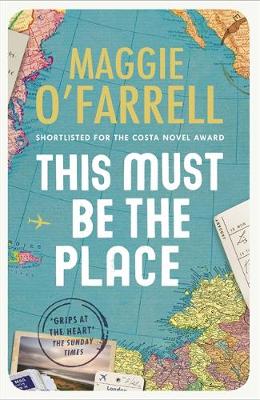
Award-winning novelist Maggie O’Farrell returns with her latest breathtaking novel. This Must Be The Place is a story about journeys, it’s about discovering who you are and where you’re meant … Continue reading This Must be the Place by Maggie O’Farrell



 A heart-wrenching and powerful YA story exploring themes of loss, love and discovery, from award-winning, bestselling author, Gayle Forman
 A fiery, fast-paced, bullet of a read, and the last in the Robert Finlay trilogy. Continuing on from ‘Deadly Game’, Robert Finlay and Kevin Jones find themselves in the middle of a whole heap of trouble. A Superintendent from the Complaints Investigation Branch is on the warpath, and then quite separately, a document from the past puts the two men directly in the firing line, and things turn very, very personal. Matt Johnson has the most credible and authentic voice, he blends his knowledge as a soldier and police officer into an absolutely cracking storyline. Finlay’s post traumatic stress disorder can clearly be felt in the small but biting descriptions of PTSD, it is a part of him, but not the whole of him, and he is an incredibly engaging character. A suitably dramatic end ensured I was kept on the edge of my seat. ‘The Robert Finlay’ trilogy has been a thunderingly good read, and ‘End Game’ is a wonderfully thrilling, gripping, and fitting conclusion. – Liz Robinson
 Matt Johnson served as a soldier and Metropolitan Police officer for twenty-five years. Blown off his feet at the London Baltic Exchange bombing in 1993, and one of the first police officers on the scene of the 1982 Regent’s Park bombing, Matt was also at the Libyan People’s Bureau shooting in 1984 where he escorted his mortally wounded friend and colleague, Yvonne Fletcher, to hospital. Hidden wounds took their toll. In 1999, Matt was discharged from the police with Post Traumatic Stress Disorder.
 Oh, what a truly beautiful read this is, though do prepare for your heart to ache, weep, and possibly even break. For the last ten years, Oliver Loving has been lying in a hospital bed, paralysed and non-communicative, is he trapped in his own mind, can a new test release him? Everyone wants answers, they also want to know what happened ten years ago, on the night of the school dance in Bliss, Texas… and what caused the tragedy that took place there. The story focusses on Oliver, his mother Eve, and brother Charlie, and how one event has trapped them, has maimed them all. Stefan Merrill Block writes so thoughtfully, an almost gentle lyrical quality caresses the pages, yet he encourages searching questions, for you to travel deeper, to look further.
 1793, As the Terror begins to cast a great shadow over France, Thomas Pryce, the new Vicar of Deal, crosses the Channel to find the missing parents of his beautiful French wife. Facing grave dangers, he makes his way to Brittany where he not only discovers the fate of his in-laws but also uncovers a plot which threatens to topple the British monarchy. Fighting against a sinister secret society in a race against time, Pryce battles to thwart the plans of a Parisian spymaster and his agents in London.


 Tales Before Bedtime